Who was ‘El Mencho’? What drug lord’s killing means for Mexico
The US-backed operation that killed ‘El Mencho’ sparks a wave of violence across the country.
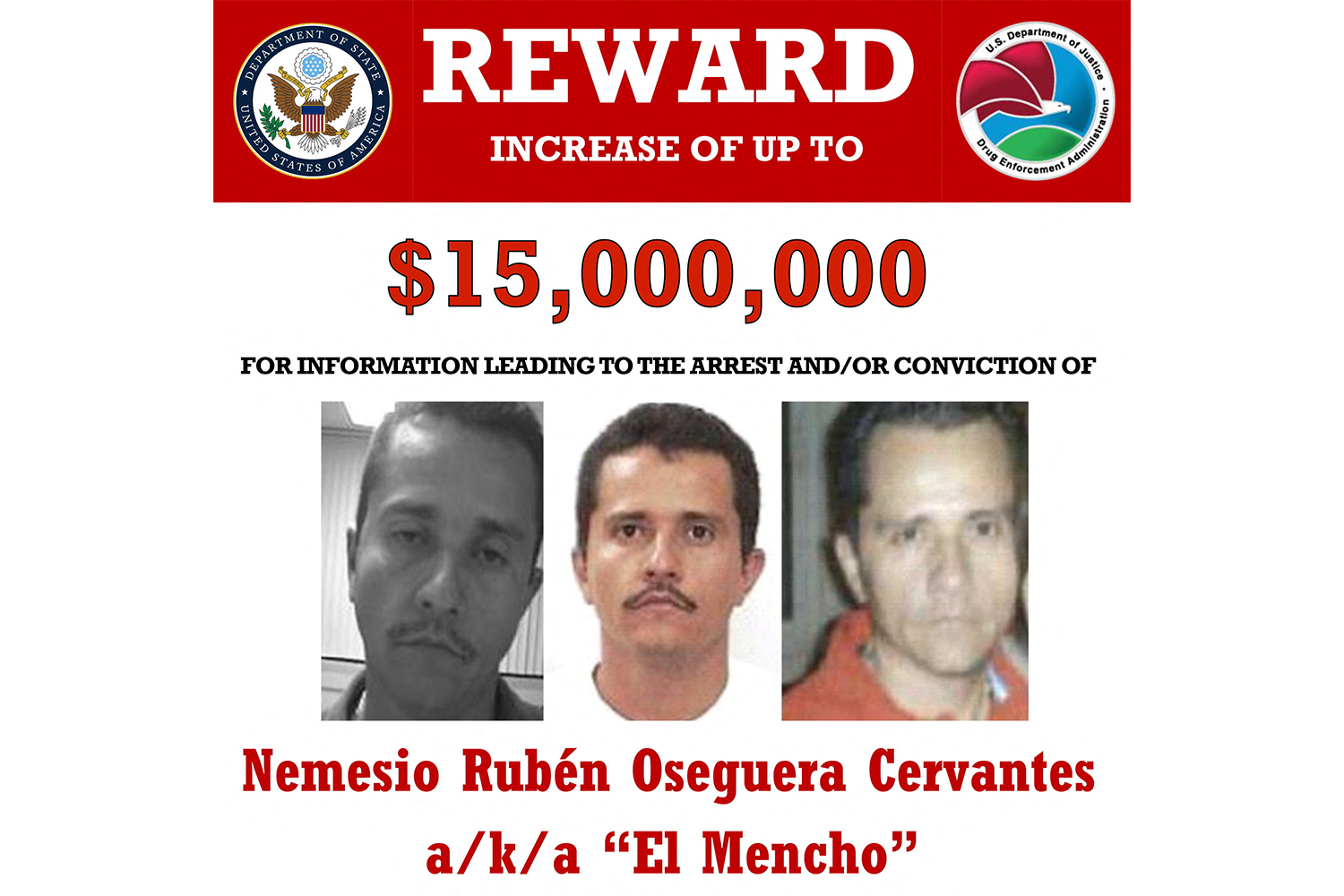
Mexico's most powerful drug boss ‘El Mencho’ killed, sparking cartel violence nationwide

In a military raid supported by the United States, Mexican forces have located and killed one of the country’s most wanted drug lords, Nemesio Oseguera Cervantes, also known as “El Mencho”.
In the immediate aftermath of his killing on Sunday, violence erupted in numerous areas of Mexico as armed men set vehicles ablaze and erected roadblocks across approximately 20 states.
We break down who “El Mencho” was, how he was killed and what his death means for the US and Mexico.
Who was ‘El Mencho’?
He was the leader of the Jalisco New Generation Cartel, which operates from the western state of Jalisco and is known for its large military-style arsenal.
Aged 59 when he was killed, El Mencho was from the neighbouring state of Michoacan. It is rumoured that he was a police officer before he became a drug lord.
He rose in the ranks of Mexico’s drug-trafficking underworld in the 1990s. In 1994, he was convicted in the US of heroin trafficking and served nearly three years in prison before returning to Mexico.
There are plenty of stories about El Mencho’s methods of dealing with adversaries.
He once sent a severed pig’s head in an ice chest to a Mexican lawyer as a threat, Rolling Stone magazine reported in 2015, quoting an unnamed former field agent with the US Drug Enforcement Administration (DEA).
A recording of a call captured him threatening a local police commander with the call sign “Delta One”, promising to kill him “and even your dogs” if his officers did not back off, then ending with a nonchalant “sorry for the bad language”.
As El Mencho rose to become a powerful drug dealer, he began to heavily invest in submarines, which he used to transport drugs from South America to the US, Rolling Stone reported. The magazine quoted the former DEA agent as saying El Mencho hired Russian naval engineers to help design the submarines.
He became one of Washington’s most wanted fugitives, and the US had offered a $15m reward for information leading to his arrest.
Annette Idler, an associate professor in Global Security at the University of Oxford, told Al Jazeera that El Mencho’s death is symbolically important because he was central to the Jalisco Cartel’s transformation into one of the most powerful and globally connected criminal organisations.
Idler added that this was “particularly so in fentanyl production linking Mexico to China, and cocaine trafficking networks linking it to South America, especially Ecuador and Colombia”.
What is known about the Jalisco New Generation Cartel?
El Mencho founded the cartel in 2009 and rapidly expanded it, using online recruitment and diversifying its income streams through fuel theft, extortion, timeshare scams and other rackets.
The US has identified the Jalisco Cartel and the Sinaloa Cartel as the organisations primarily responsible for trafficking fentanyl into the country in recent years. The DEA considers the Jalisco Cartel to be as powerful as Sinaloa, with a presence in all 50 US states. The DEA said it is active in 21 of Mexico’s 32 states.
The Jalisco Cartel has become notorious for its assaults on Mexican security forces. In 2015, it shot down a military helicopter in Jalisco.
In 2020, it tried to kill then-Mexico City police chief Omar Garcia Harfuch, who now serves as the federal security secretary.
In February last year, Mexico handed over senior Jalisco Cartel leader Antonio Oseguera Cervantes, El Mencho’s brother, to the US. This came days after the US designated eight Latin American criminal and drug-trafficking groups as “global terrorist organisations”, including the Jalisco Cartel.
How did El Mencho die?
El Mencho was killed by Mexican special forces during a military operation to capture him in Tapalpa in the southern part of Jalisco on Sunday.
Troops were sent in to arrest El Mencho, and his followers tried to fight them off. Authorities said he was killed during the operation.
What do we know about the operation?
Mexican President Claudia Sheinbaum said on X on Sunday that the Secretariat of National Defence reported the operation had been carried out by federal forces.
“My recognition to the Mexican Army, National Guard, Armed Forces, and Security Cabinet,” Sheinbaum wrote.
White House press secretary Karoline Leavitt wrote on X that the US had provided intelligence to the Mexican government to assist with the operation.
“In this operation, three additional cartel members were killed, three were wounded, and two were arrested,” Leavitt posted. Authorities have not confirmed their identities.
How significant is the US involvement?
Benjamin Smith, a professor of Latin American history at the University of Warwick in the United Kingdom, told Al Jazeera that the most recent captures of Mexican drug bosses have been backed by the US. “This is not new,” he said.
Vanessa Rubio-Marquez, associate dean for extended education for the School of Public Policy at the London School of Economics, said the US involvement in the operation “speaks about the need to have permanent and effective dialogue and cooperation between both countries”.
“As a transnational activity that includes import of precursors, production, trafficking, consumption, money laundering, flow of arms, extortion and corruption from both sides of the border, both countries need to work together to combat these organisations and their unlawful activities and being able to protect citizens,” said Rubio-Marquez, who has represented Mexico in various international fora, including the United Nations and the International Monetary Fund.
What has happened since El Mencho’s killing?
Violence erupted on Sunday in at least 20 Mexican states, including Jalisco, Colima, Michoacan, Nayarit, Guanajuato and Tamaulipas.
Officials in Jalisco, Michoacan and Guanajuato reported that at least 14 people were killed in Sunday’s violence, including seven members of the National Guard.
Jalisco’s capital, Guadalajara, which is to host several matches in this year’s FIFA World Cup, was largely shut down on Sunday night as residents sheltered indoors. Four high-level football matches planned for Sunday were postponed.
Videos on social media showed passengers running in panic through Guadalajara’s airport and smoke rising over the resort city of Puerto Vallarta. Governor Pablo Lemus urged people to stay home and suspended public transport while schools were closed on Monday in several states.
The US embassy in Mexico issued a security alert for US citizens in Jalisco, Tamaulipas, Michoacan, Guerrero and Nuevo Leon, advising them to stay indoors.
How have Mexicans reacted?
Analysts said the Mexican public is mostly supportive of the government’s actions to rein in the cartels.
“There is some risk that visible US involvement could trigger criticism or perceptions of external pressure, particularly around fentanyl and trade politics,” Idler said.
“At the same time, successfully removing a major cartel leader strengthens the government’s security credentials and may reduce US political pressure for more aggressive unilateral measures. The domestic impact will largely depend on whether violence stabilises or escalates in the aftermath.”
The government reported in December that the average number of killings per day in Mexico had dropped by 37 percent since Sheinbaum took office in October 2024.
“She’s extremely popular,” Smith said. “And Mencho was broadly loathed.”
Sheinbaum had an approval rating of about 70 percent as of late January, according to the Americas Society and Council of the Americas, New York-based organisations focused on promoting cultural and political understanding and business ties in the Americas. The rating has been consistent since Sheinbaum was elected.
“It was widely known – and criticised – that President Claudia Sheinbaum’s predecessor, Andres Manuel Lopez Obrador, followed a policy of ‘hugs not bullets’,” Rubio-Marquez said.
“This is a clear U-turn to this former policy by a Morena [Lopez Obrador and Sheinbaum’s party] government and an implicit recognition that crime has to be confronted with decision and a sophisticated strategy that includes information, intelligence and cooperation with the US and coordination and training with actors at the different levels of government.”
What might happen next?
The operation that killed El Mencho could benefit Mexico in its negotiations with US President Donald Trump’s administration, which has threatened to impose tariffs or even resort to military action if Mexico does not clamp down on drug cartels.
However, experts said the operation could lead to a new wave of violence in Mexico because cartels may retaliate against security forces. Smith said the operation could result in “more public murders”.
“For the last year, the Mexican state has managed to bring down homicides. I suspect this killing will reverse that trend,” he said.
Idler agreed that El Mencho’s killing would not automatically affect volumes of narcotics trafficking.
“The underlying structure of the globally networked illicit supply chains that [Jalisco Cartel] has been involved in remains intact, and so it is unlikely that we will see any immediate change in levels of drug trafficking or other illicit economic activities,” Idler said.
It is unclear what the future holds for the Jalisco New Generation Cartel because El Mencho’s death has left a power vacuum, and it is unknown who will succeed him.
“The fight against criminal actors is not only about getting rid of leaders and bringing them to justice,” Rubio-Marquez said. “It implies a complex strategy that includes prevention, the combat of powerful arms used by cartels, the disarticulation of their multi-layered networks, security and protection for citizens, and effective policies towards social inclusion and social cohesion, economic development.”
