Trump makes Iran missile, protest deaths claims; Tehran slams ‘big lies’
Trump strikes belligerent tone on Iran during State of the Union, drawing a fierce response from Tehran.
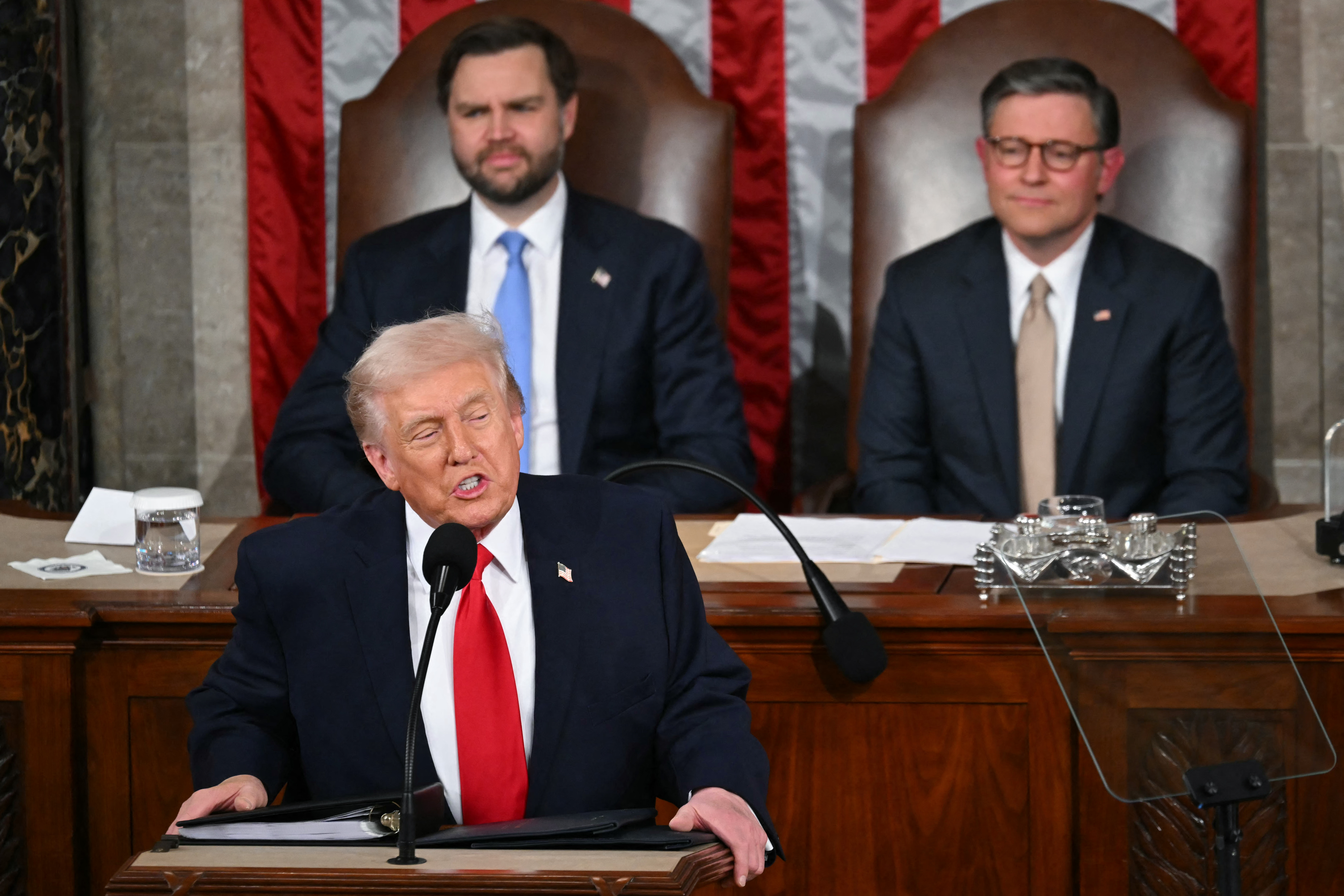

United States President Donald Trump has told Congress that he would prefer to resolve differences with Tehran through diplomacy, while laying out his case for potential attacks on Iran, which he claimed was seeking to develop missiles that could strike the US mainland.
His comments have drawn an angry response from the Iranian government on Wednesday, the day before the two sides are due to resume indirect talks in Geneva.
Iran’s negotiating delegation, led by Foreign Minister Abbas Araghchi, has left Tehran headed for the Swiss city, state media reported on Wednesday.
During his annual State of the Union address to a joint session of the Senate and House of Representatives on Tuesday, Trump struck a belligerent tone against Iran, accusing it of working to rebuild its nuclear programme that was hit by US strikes last year.
Trump has repeatedly said those sites were obliterated, a claim experts have disputed.
“We wiped it out and they want to start all over again. And they’re at this moment again pursuing their sinister ambitions,” Trump said, as he broached the subject of potential military action against Iran about 90 minutes into his record-length speech.
“We are in negotiations with them. They want to make a deal, but we haven’t heard those secret words: ‘We will never have a nuclear weapon.’”
Trump said his “preference” was “to solve this problem through diplomacy, but one thing is certain: I will never allow the world’s number one sponsor of terror, which they are by far, to have a nuclear weapon.
“Can’t let that happen,” he added.
Trump said that after the US attacks on Iran’s nuclear sites in June 2025, “they were warned to make no future attempts to rebuild their weapons programme, in particular, nuclear weapons – yet they continue”.
Iran has insisted for years that its nuclear programme is for civilian purposes only. Neither US intelligence nor the UN’s nuclear watchdog found any evidence last year that Iran was pursuing atomic weapons.
As well as accusing Iran of restarting its nuclear programme, Trump claimed Tehran was working to build missiles that “soon” would be capable of reaching the US, echoing claims in Iranian state media that Tehran is developing a missile capable of reaching North America.
He also claimed Iran was responsible for roadside bombings that have killed US service members and civilians.
He criticised Tehran over the deaths of thousands of protesters killed during recent antigovernment demonstrations, claiming that Iranian authorities killed 32,000 people during a crackdown – much higher than the thousands widely believed to have been killed.
“The (Iranian) regime and its murderous proxies have spread nothing but terrorism and death and hate,” Trump said.
Iran’s Foreign Ministry responds
Trump’s latest comments on the tensions come amid a significant US military build-up in the Middle East, and before a third round of indirect talks scheduled for Thursday.
Trump said on February 19 said he was giving Tehran 10 to 15 days to make a deal.
The talks, to be held in Geneva and mediated by Oman, will be attended by Trump envoys Steve Witkoff and Jared Kushner, along with Iranian officials, including Araghchi.
The US leader’s comments drew a fierce response from Iran’s Foreign Ministry on Wednesday, with ministry spokesman Esmaeil Baghaei accusing Trump of “big lies” in his claims about his government.
“Professional liars are good at creating the ‘illusion of truth’,” he said in a post on X.
“Whatever they’re alleging in regards to Iran’s nuclear program, Iran’s ballistic missiles, and the number of casualties during January’s unrest is simply the repetition of ‘big lies’.”
He added: “No one should be fooled by these prominent untruths.”
Pezeskhian: ‘Positive outlook’ for talks
Iranian President Masoud Pezeshkian said Wednesday that a “positive outlook” was visible regarding the imminent talks, amid extensive efforts being made in Iran’s foreign policy.
“God willing, this process will continue at the upcoming meeting in Geneva,” he said.
He said efforts had been made, under the direction of Iran’s Supreme Leader Ayatollah Ali Khamenei, “to manage this path in a way that moves beyond the exhausting ‘neither war nor peace’ situation”.
If those efforts were successful, he said, then it would assist the country’s development goals.
‘All options on table’
Pezeshkian’s comments came as Mohammad Bagher Ghalibaf, speaker of Iran’s Parliament, said that Iran remained committed to negotiations, while warning that it was prepared to retaliate if Washington once again resorted to military action.
“If you choose the path of diplomacy – one in which Iranian dignity and mutual interests are respected – we will remain at the negotiating table, as we are now,” said Ghalibaf.
“We have the third round of talks tomorrow, and we will continue on this path in the future as well.”
But, he said, “if your decision is to repeat what happened before – through deception, lies, and misinformation – and to bomb the negotiating table while Iran is pursuing diplomacy under these conditions, then you will once again taste the strong blow of the Iranian nation and our defensive forces”.
He added: “All options are on the table: both dignified diplomacy and a deterrent defence that will make you regret your actions.”
Earlier on Tuesday, Araghchi said in a post on X that a deal with Washington to avert conflict was “within reach”, as Iran prepared to resume talks in Geneva “with a determination to achieve a fair and equitable deal – in the shortest possible time”.
“Our fundamental convictions are crystal clear,” he wrote. “Iran will under no circumstances ever develop a nuclear weapon; neither will we Iranians ever forgo our right to harness the dividends of peaceful nuclear technology for our people.”
Iran and the US had “a historic opportunity to strike an unprecedented agreement”, he said, “but only if diplomacy is given priority”.
Trump trying to build support for strikes
Hassan Mneimneh, researcher at the Washington-based Middle East Institute, told Al Jazeera that Trump’s comments on the supposed threat of Iranian missiles appeared to be a bid to drum up domestic support for a military operation against Iran, something he was struggling to achieve.
Trump was attempting to do this by painting Iran’s missiles as a direct threat to the US, even though the arsenal was primarily a threat to Israel, he said, lacking the capacity to strike the United States.
He said the ongoing negotiations appeared to be a futile process, with the US insisting that the talks would cover Iran’s missile programme, which was not originally on the negotiating table.
