Syrian forces enter SDF-stronghold of Qamishli under ceasefire deal
Damascus says forces entering city in northeastern Hasakah province ‘to commence security duties’ under US-backed deal.
Syrian army gains control: Kurdish-led SDF pulls out of stronghold Qamishli

Syrian government forces have entered the northeastern city of Qamishli, one of the last strongholds of the Kurdish-led Syrian Democratic Forces (SDF), as part of a ceasefire deal with the group.
The official SANA news agency, citing the Syrian Interior Ministry, reported on Tuesday that units began entering the city in Hasakah province “to implement the terms” of a ceasefire deal agreed upon with the SDF and “commence their security duties”.
Recommended Stories
list of 4 items- list 1 of 4US abandoning the SDF has impacted Kurds across the region
- list 2 of 4Photos: Syrian army enters Kurdish city of Hasakah as ceasefire takes hold
- list 3 of 4‘False narrative’: Families challenge Trump’s 75-country US visa suspension
- list 4 of 4Syrian forces deploy in Hasakah under ceasefire agreement with SDF
The deal, agreed to on Friday, ended weeks of tensions and armed confrontations with advancing government troops, paving the way for the SDF to integrate into Syria’s state institutions.
Security was visibly tightened on the main road leading into Qamishli, ahead of the deployment.
The streets were largely empty, since the SDF had imposed a curfew, with shops shuttered and heavily armed SDF troops and local Kurdish security forces spread across major roads and intersections.
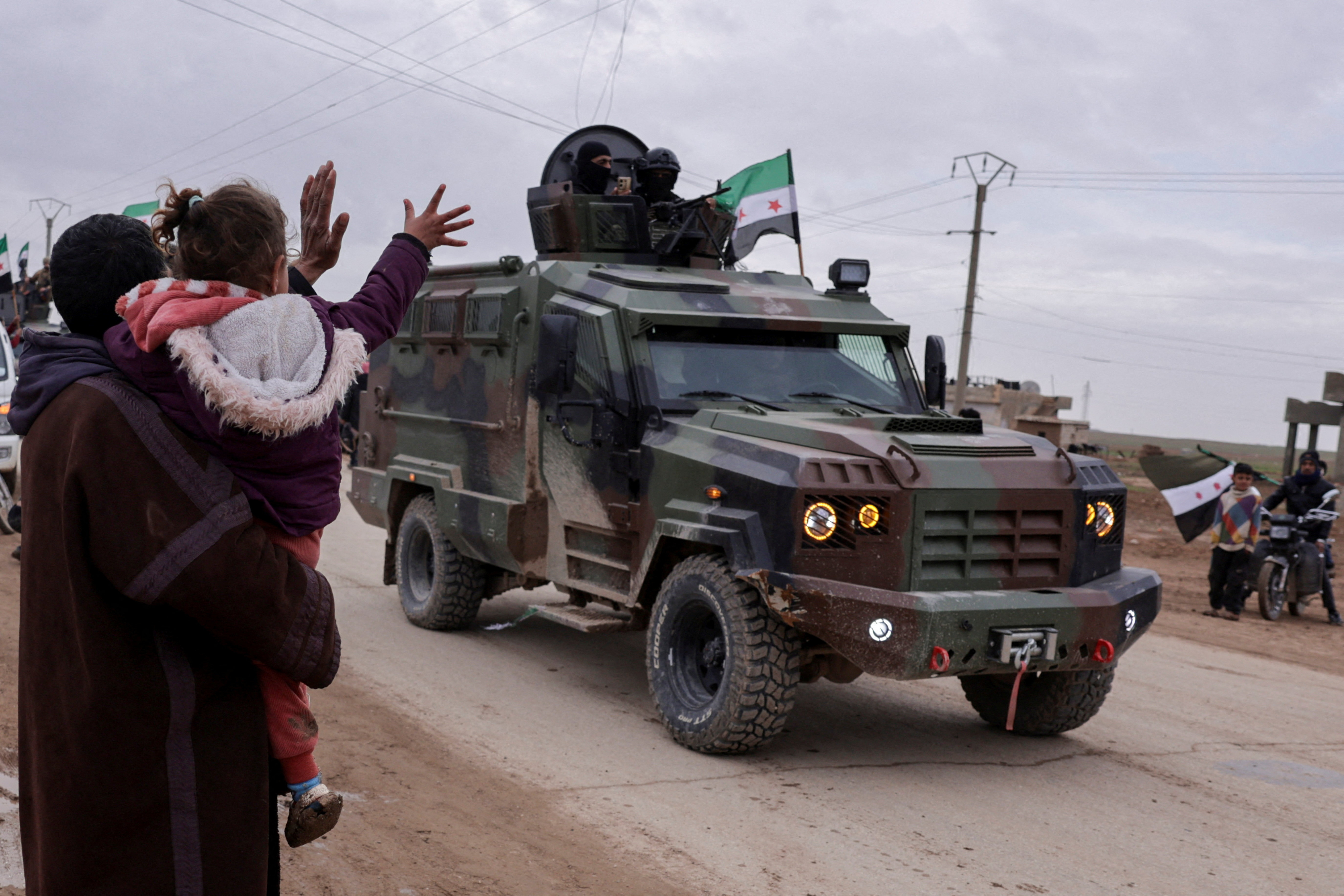
The convoy of Syrian army vehicles, bearing Syrian flags, headed straight to a security zone inside Qamishli for talks with senior Kurdish officials, according to the Reuters news agency. The northeastern city was considered the capital of the Kurdish-led administration in a region called Rojava, which the SDF took control of during Syria’s 14-year civil war.
Interior Ministry spokesman Nur Din al-Baba, speaking in Qamishli, said Syrian government forces were handed control of the security buildings of the SDF’s internal security forces, Asayish, and would deploy alongside the Asayish to maintain security in the city.
“Today the Syrian people won … and we begin a new chapter away from revenge, hate speech and divisions,” he said.
‘The Syrian people are one’
Before arriving in Qamishli, the convoy entered Tell Brak, east of the city of Hasakah, as crowds lined the roads, waving Syrian flags and cheering their arrival.
People chanted through megaphones, “The Syrian people are one!” Some men fired celebratory gunfire into the air while women ululated.
Syria’s army moved into the city of Hasakah under the deal on Monday.
Al Jazeera’s Teresa Bo, reporting from near Tell Brak, said hundreds of people were following the convoy and explained that the operation enjoyed “lots of support”, particularly among the local Arab population, as well as within some segments of the Kurdish population.
“People here celebrating the arrival of Syrian army,” she said. “They stress the importance of a united Syria. They have been struggling for years under Syria’s civil war, and now they say they need to move forward,” she added.
Adel al-Ahmad was among those welcoming the convoy.
He said he hoped the “Syrian army becomes the one in control” and that “this happiness is spread across Syria, north to south to east to west”. He also expressed contentment over what he described as “the liberation of Al-Hasakah from the SDF as well as Qamishli, where the SDF is still present, in addition to Al-Jawaliyeh and Kahtaniyeh and Al-Malikiyah” cities.
Arab residents in SDF‑controlled areas have long complained of political and economic marginalisation, while many Kurdish communities fear reprisals from government‑affiliated fighters, concerns sharpened by killings and retaliatory attacks that erupted across Syria in 2025, especially in coastal and southern regions.
“We are happy with the entry of the internal security to Al-Hasakeh on the way to Qamishli,” said Wissam al-Motlak, another spectator.
Ceasefire agreement
Friday’s deal staved off the prospect of further confrontation between Syrian President Ahmed al-Sharaa’s government and the SDF, which lost swaths of eastern and northern Syria to government troops in January.
Hailed by the United States as an important step towards unity and reconciliation, the accord foresees a phased integration of Kurdish fighters into the government’s forces.
Al Jazeera’s Bo said the agreement marked a “big change”, especially for people living in previously SDF-led areas.
“Most of the people we have seen around here [in the Qamishli area] are extremely happy. They say this is the beginning of a new Syria and that this is what the country needs in order to be able to move forward and start reconstruction,” said Bo.
“But the challenges ahead are many,” she said. “These include integrating rival administrations, security forces and laws into one national system. Building trust is the only way forward in a shared state.”
The Kurds were an oppressed minority under the 54-year rule of the al-Assad family and established de facto autonomy during the civil war in a largely Arab-populated region.
The SDF, which controlled Syria’s main oil fields and a basket of key commodities during the family’s rule, says it sought to redress injustices by creating a system of governance that represented all ethnic groups and minorities.
The Kurdish-led force was once the US’s main ally in Syria, playing a vital part in the fight against the ISIL or ISIS group.
But its position took a major hit as US President Donald Trump cultivated relations with al-Sharaa, who came to power after the fall of longtime leader Bashar al-Assad in December 2024. The former commander has now brought almost all of Syria back under the authority of Damascus.
Al Jazeera’s Zeina Khodr, reporting from Aleppo in northern Syria, said the SDF’s integration process is expected to be “slow and gradual” amid a “deep history of mistrust” among Kurds.
“Taking territory is one thing, but maintaining security and stability is another,” Khodr said. “It’s a very difficult road ahead.”
