Building collapse in Lebanon’s Tripoli kills at least 14 people
Eight people pulled alive from rubble as latest building collapse prompts anger in northern town.
At least six dead, several buried under rubble after building collapses in northern Lebanon

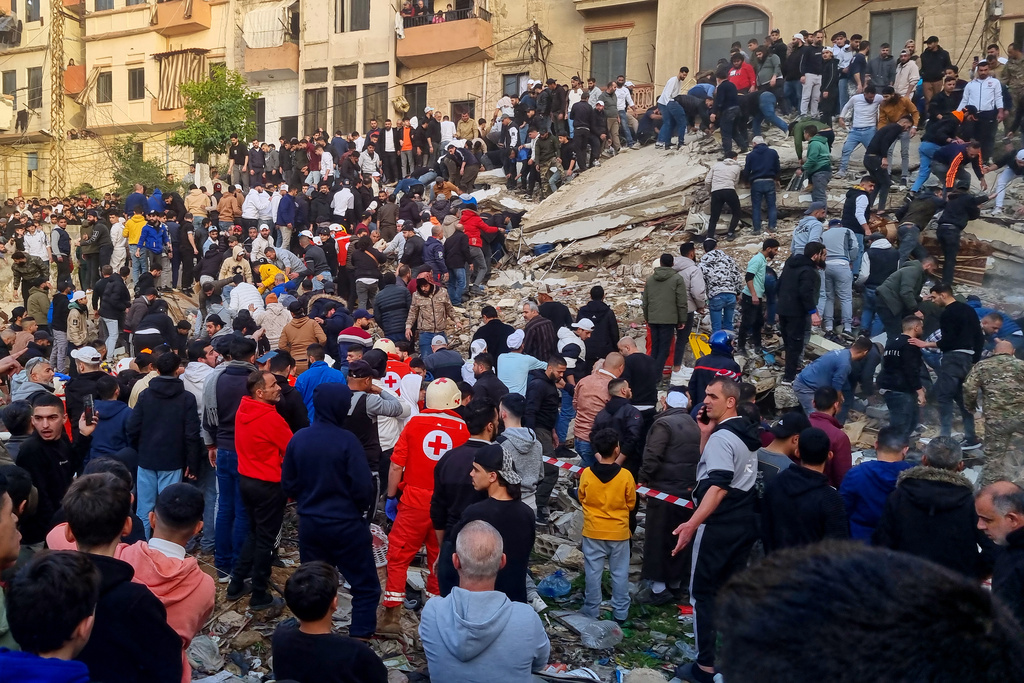
At least 14 people have been killed and several others injured when two adjoining buildings collapsed in the northern Lebanese city of Tripoli, according to officials.
The civil defence announced on Monday the end of the search-and-rescue operations after recovering the bodies of 14 victims, up from an earlier death toll of nine. Eight people were pulled alive from the rubble, it said.
Recommended Stories
list of 3 items- list 1 of 3Israel sprays unknown chemical over land in south Lebanon
- list 2 of 3Israel’s war on Gaza’s healthcare continues in full force under ‘ceasefire’
- list 3 of 3Week in Pictures: From Israeli air raids on Lebanon to bombing in Pakistan
The building consisted of two blocks, each containing six apartments, according to the civil defence, which was supported in its operation by the Lebanese Red Cross and emergency and relief agencies.
Residents of the neighbourhood also took part in rescue efforts, rushing to help remove debris and create openings in the collapsed building.
![Rescue workers and residents search for survivors in the rubble of a building that collapsed in the northern city of Tripoli, Lebanon, Sunday, February 8, 2026 [AP]](/wp-content/uploads/2026/02/AP26039563507455-1770580175.jpg?w=770&resize=770%2C513&quality=80)
Members of the Internal Security Forces and Tripoli municipal police have evacuated residential buildings adjacent to the collapsed building, fearing their collapse, Lebanon’s state-run National News Agency (NNA) reported.
Lebanese President Joseph Aoun ordered all emergency services to be on high alert to assist in rescue operations and to provide shelter for the residents of the neighbouring buildings, according to the NNA report.
Prime Minister Nawaf Salam said in a statement that the government is fully prepared to provide housing allowances for all residents of buildings that need to be evacuated.
“Given the magnitude of this humanitarian catastrophe, the result of years of accumulated neglect, and out of respect for the lives of the victims, I urge all those involved in politics, in Tripoli and elsewhere, to refrain from exploiting this horrific disaster for cheap and short-sighted political gains,” he said.
Unsafe structures
Mayor Abdel Hamid Karimeh told journalists that “we declare Tripoli a disaster-stricken city” due to the unsafe buildings.
“Thousands of our people in Tripoli are threatened due to years of neglect,” he said. “The situation is beyond the capabilities of the Tripoli municipality.”
Al Jazeera’s Zeina Khodr, reporting from Tripoli, Lebanon, said “there is a lot of anger” in the town, where “many poor neighbourhoods have buildings that are at risk of collapse”. She said those living in unsafe structures have “nowhere to go” and that several months’ worth of housing allowances “will not solve (their) problem”.
Minister of Justice Adel Nassar asked the public prosecutor in the north to open an immediate investigation into the incident, the NNA said, reporting that procedures had begun.
This latest disaster came after another deadly building collapse in Tripoli late last month.
In January, the head of the higher relief authority, Bassam Nablusi, citing Tripoli municipality statistics, said 105 buildings required “immediate warning notices to their residents to evacuate”.
Lebanon is dotted with derelict buildings, and many inhabited structures are in an advanced state of disrepair.
Many buildings were built illegally, especially during the 1975-1990 civil war, while some owners have added new floors to existing apartment blocks without permits.
Al Jazeera’s Khodr said that “successive governments have been accused of neglecting the city” following the civil war, worsening the crisis.
