US-Iran ceasefire deal: What are the terms, and what’s next?
US and Israel to halt attacks on Iran for two weeks, while Tehran agrees to reopen the Strait of Hormuz.
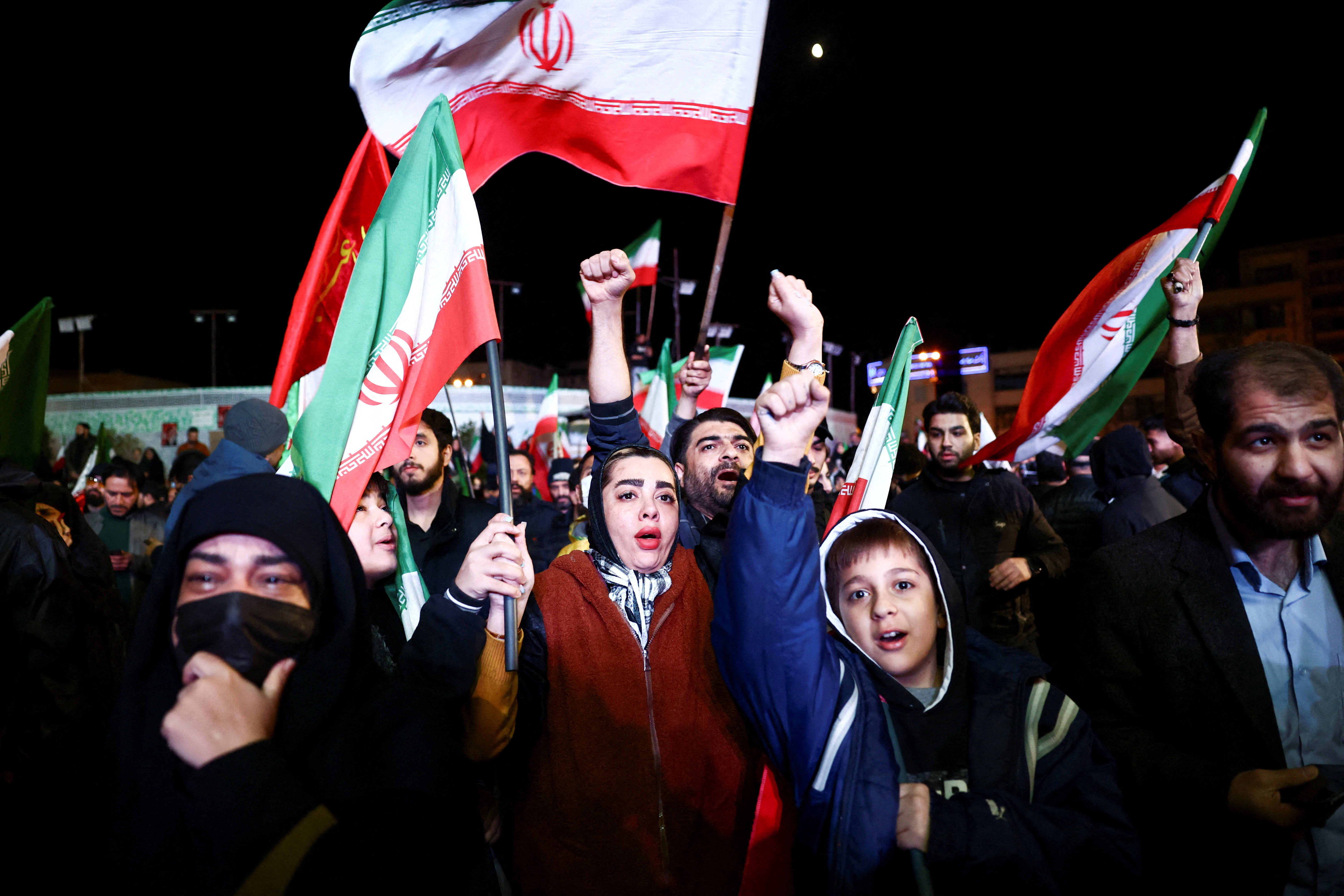

A two-week ceasefire between the United States and Iran has halted 40 days of US-Israeli attacks on Iran that had pushed the region to the brink of a wider war.
The truce, brokered by Pakistan, follows fierce exchanges of air strikes, missile attacks and threats that saw unprecedented strikes on Gulf nations, disrupted global shipping routes and heightened fears of a prolonged confrontation.
Recommended Stories
list of 3 items- list 1 of 3Netanyahu says US-Iran ceasefire ‘does not include Lebanon’
- list 2 of 3Iraqis celebrates US-Iran ceasefire as two-week halt in war begins
- list 3 of 3Climate activist Greta Thunberg slams Trump’s threats against Iran
“Both parties have displayed remarkable wisdom and understanding and have remained constructively engaged in furthering the cause of peace and stability,” Pakistani Prime Minister Shehbaz Sharif posted on X, while announcing the cessation of hostilities.
Iran has also confirmed it will allow the resumption of shipping across the Strait of Hormuz during the two-week period, easing a disruption which had sent global oil and gas prices soaring. Israel has also announced it will halt its attacks on its longtime foe.
Nevertheless, many questions remain as Washington and Tehran remain poles apart on what they view as a comprehensive agreement, while Iran, the United Arab Emirates and Kuwait reported attacks just hours into the truce.
Robert Geist Pinfold, a political analyst, said the new US-Iran ceasefire deal remains very uncertain in scope and implementation.
“Overall, the issue with the ceasefire deal is everyone, as usual, is claiming victory, and there are still continued violations of the ceasefire,” he said.
Pinfold, a lecturer in international security at King’s College London, noted key details have yet to be clarified, including whether the agreement extends to Lebanon. “Israel maintains it will not. Pakistan maintains that it will,” he added.
Negotiations expected to begin in Islamabad on Friday will test whether this truce can be converted into a more durable arrangement.
So, what do we know about this two-week ceasefire and what happens next?
What has the US agreed to?
Under the terms of the ceasefire, the United States has agreed to halt its military strikes on Iran for an initial two-week period, claiming all of Washington’s military objectives had been “met” and Iran had agreed to the “complete, immediate and safe opening” of the Strait of Hormuz.
The strait is a key passageway for one-fifth of the world’s oil and gas, which Tehran closed in retaliation for the US-Israeli war launched on February 28.
Moreover, Trump said the US has received a 10-point proposal from Iran, which he called a “workable basis on which to negotiate”.
“Almost all of the various points of past contention have been agreed to between the United States and Iran, but a two-week period will allow the Agreement to be finalised and consummated,” he said on his social media platform Truth Social.
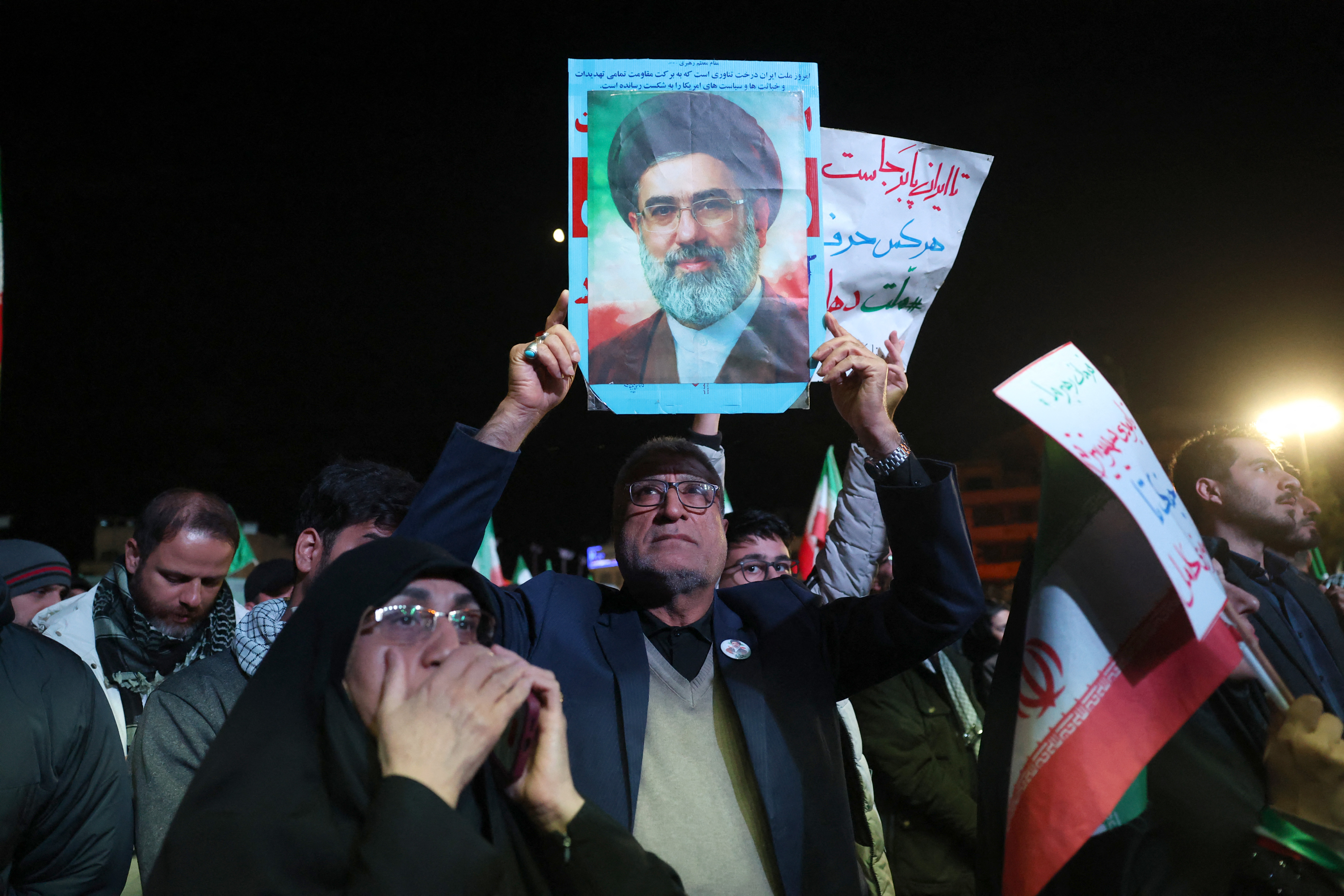
While the full 10-point plan has not been made public, Al Jazeera’s Diplomatic Editor James Bays has reported that it includes the following:
- Fundamental commitment to non-aggression from the US.
- Controlled passage through the Strait of Hormuz in coordination with the Iranian armed forces, which would mean that Iran retains its leverage over the waterway.
- An acceptance of Iran’s nuclear enrichment programme.
- The lifting of all primary and secondary sanctions and resolutions against Iran.
- End of all resolutions against Iran at the International Atomic Energy Agency.
- End of all resolutions against Iran by the United Nations Security Council.
- The withdrawal of US combat forces from all bases in the region.
- Full compensation for damages suffered by Iran during the war – to be secured through payments to Iran by ships passing through the Strait of Hormuz.
- The release of all Iranian assets and properties frozen abroad.
- The ratification of all these matters in a binding UNSC resolution.
But Trump insisted in comments to the AFP news agency that Iran’s nuclear stockpile would be “taken care of” in any peace deal.
“That will be perfectly taken care of, or I wouldn’t have settled,” Trump told AFP. Iran insists it is not seeking to build nuclear weapons, but says it is willing to negotiate limits on its nuclear activities in return for sanctions relief.
Trump also told AFP that China had helped bring Iran to the negotiating table, while Turkiye and Egypt had also been mediating in recent days.
Later, in an interview with Sky News, Trump seemed to suggest that the 10-point plan that Iranian officials have formally leaked is different from the one actually under negotiation.
“They’re very good points – and most of them have been fully negotiated,” he told Sky News. “They’re not the maximalist demands that Iran is claiming.
“If it [negotiations from here on] isn’t good, we’ll go right back to it [fighting] very easily,” the US president added.
Pinfold said the ceasefire agreement was “very similar” to what he described as the “Gaza peace plan”, where a six-month “ceasefire” exists despite near-daily violations by the Israeli army.
“All sides seem to have basically agreed to disagree and have kicked a lot of their disagreements into the long grass. No one is really clear who has agreed to what for the time being.”
Since the ceasefire announcement, neither the US leader nor his administration has made any mention of key sticking points mentioned in the 10-point plan, including the lifting of US sanctions, releasing frozen Iranian assets, control over the Strait of Hormuz or the withdrawal of US forces from the region.
However, later on Wednesday, Trump seemed to harden his stance, saying there will be “no uranium enrichment”, but Washington will have discussions with Tehran over tariff and sanctions relief.
The US military’s top general, Dan Caine, said his forces were ready to resume attacks if ordered by Trump.
Meanwhile, US Secretary of Defense Pete Hegseth also warned that “we stand ready in the background to ensure that Iran upholds” the terms of the ceasefire agreement.
In particular, the US made no mention of Iran’s ballistic missile capabilities, a major feature in Iran’s retaliation against US and Israeli forces. Previously, Washington had demanded that Iran curb or severely dismantle its ballistic missile programme.
Iran has made clear that its missile programme is not up for discussion.
What has Iran agreed to?
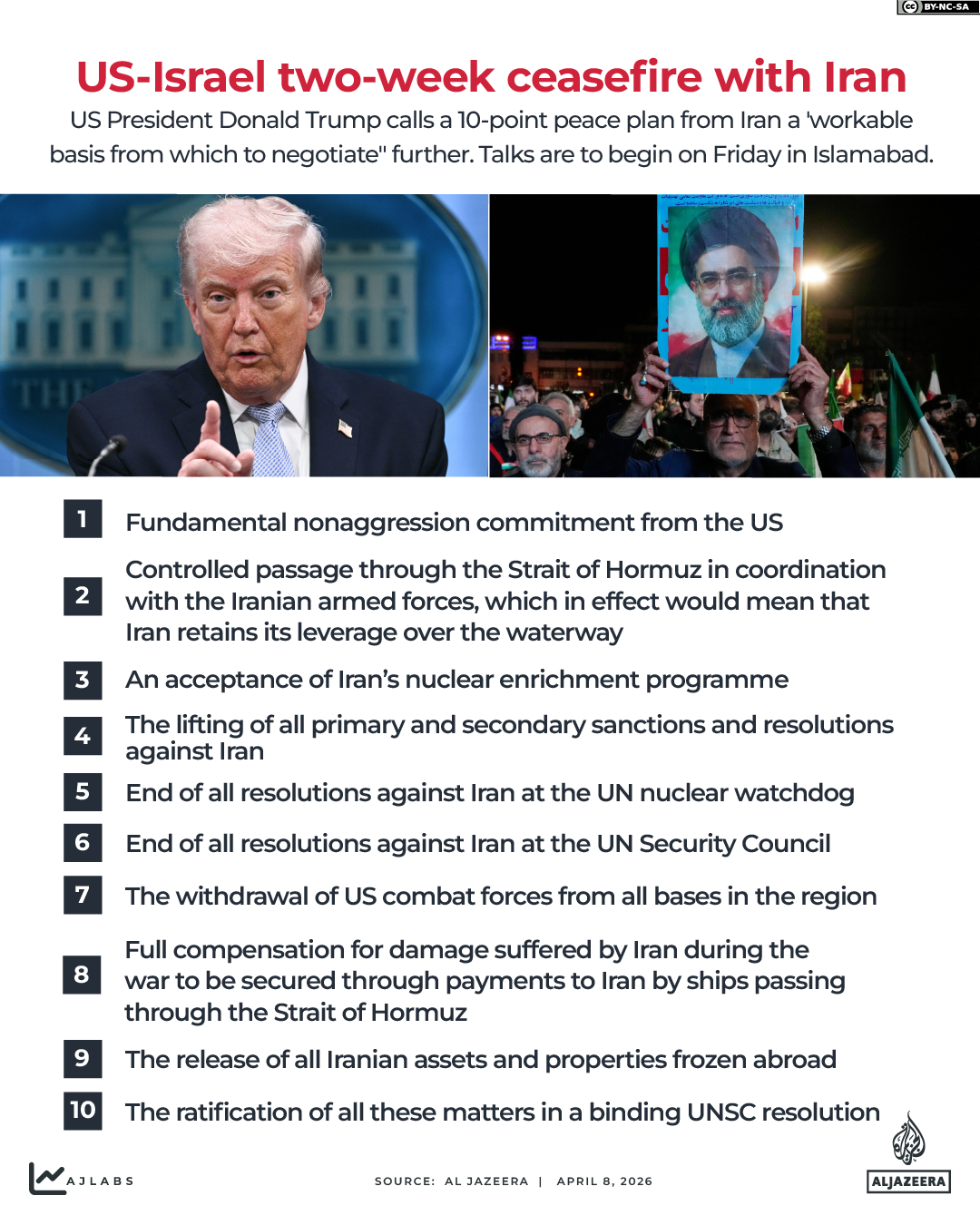
Iran has accepted the ceasefire on the condition that US and Israeli attacks stop, agreeing to pause its own retaliatory strikes during the two-week window.
“If attacks against Iran are halted, our Powerful Armed Forces will cease their defensive operations,” Iranian Foreign Minister Abbas Araghchi posted on X.
Later on Wednesday, pro-Iran armed factions in Iraq also declared a two-week cessation of their attacks on “enemy bases” in the region.
Araghchi confirmed Trump’s claims of providing safe passage to ships through the Strait of Hormuz for 14 days, adding that the resumption of activities along the strait will take place in coordination with Iranian armed forces.
The ceasefire plan also allows for Iran and Oman to charge fees on ships transiting through the water passageway, the AP news agency reported, quoting an unnamed regional official.
According to the official, the toll charged by Iran would be used for the reconstruction of the country.
Andreas Kreig, associate professor at King’s College London, said Iran believes it is in a “much better bargaining situation than they were prior to the war”.
“They have a high threshold of pain that the US cannot match,” Kreig told Al Jazeera.
“It is therefore likely that Iran will not be more willing to make concessions than in February. The question of enrichment was the point that led to the collapse of negotiation in February. Iran would want to make sure Trump surrenders this point.”
![A man assesses the damage at the site of an overnight Israeli air strike in Sidon, southern Lebanon, on April 8, 2026 [AFP]](/wp-content/uploads/2026/04/afp_69d60c953371-1775635605.jpg?w=770&resize=770%2C513&quality=80)
What has Israel agreed to?
While Israel endorsed the Pakistani-brokered ceasefire with Iran, Prime Minister Benjamin Netanyahu said it would not extend to its fighting with the Lebanese-armed group Hezbollah, or Israel’s invasion of southern Lebanon.
Netanyahu’s comments seemed to contradict Pakistani Prime Minister Shehbaz Sharif’s claims, who said the ceasefire included a halt to Israel’s attacks on Lebanon.
On Wednesday morning, the Israeli army continued its strikes in the country, issuing a new forced evacuation threat for a building near the southern city of Tyre.
“The greatest threat to any ceasefire in the region remains Israel,” King’s College’s Krieg warned, adding that Israel prefers “ambiguous ceasefire” deals that allow it to return to fighting “when it feels the situation favours the Israeli army”.
“Iran has to ensure that Israel has no easy way to return to its ‘mowing the lawn’ strategy.”
Lebanon was drawn into the US and Israel’s war on Iran on March 2 after Tehran-aligned Hezbollah launched attacks on Israel.
Hezbollah said the attacks were in retaliation for Israel’s killing of Iran’s Supreme Leader Ayatollah Ali Khamenei on the first day of the war, on February 28, as well as Israel’s near-daily violations of a ceasefire it agreed to in Lebanon in November 2024.
At least 1,497 people have been killed since the war erupted, including 57 health workers, Lebanese authorities say.
What happens next?
The immediate next step is the start of negotiations in Islamabad, where US and Iranian officials are expected to meet under Pakistani mediation.
“I warmly welcome the sagacious gesture and extend deepest gratitude to the leadership of both the countries and invite their delegations to Islamabad on Friday, 10th April 2026, to further negotiate for a conclusive agreement to settle all disputes,” Pakistani PM Sharif said.
Iran expert Trita Parsi said the potential talks in Islamabad could fail, “but the terrain has shifted”.
“Trump’s failed use of force has blunted the credibility of American military threats, introducing a new dynamic into US-Iran diplomacy,” he said.
“Washington can still rattle its sabre. But after a failed war, such threats ring hollow. The United States is no longer in a position to dictate terms; any agreement will have to rest on genuine compromise.”
