Lebanon’s military starts ‘pilot zone’ takeover in south
Three villages will be the first to implement the trilateral framework agreement between Israel, Lebanon and the US.
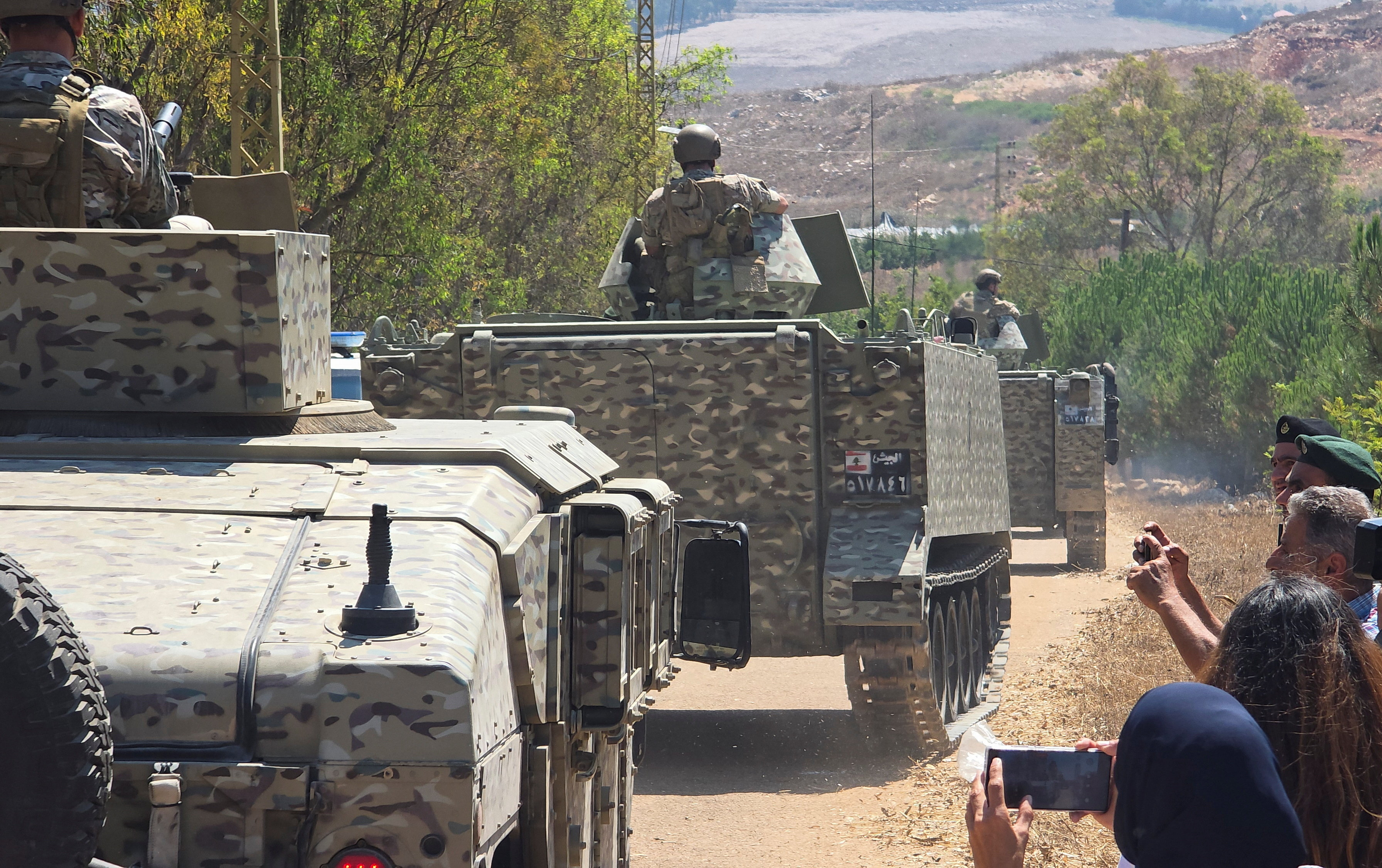

The Lebanese army on Tuesday deployed troops to the southern village of Zawtar al-Gharbiyeh, one of three “pilot zone” villages whose security it is taking over as part of a deal with Israel overseen by the United States.
Froun and Srifa are the other two villages covered by the initial phase of this initiative, according to the US State Department.
Recommended Stories
list of 3 items- list 1 of 3Who is Khalil al-Hayya, Hamas’s newly elected political chief?
- list 2 of 3Burnham’s move to scrap UK’s digital ID plans earns cheers and criticism
- list 3 of 3Petro to give farewell speech amid Colombia transfer-of-power tensions
Under the US-mediated framework agreement, the Israeli military is set to perform a phased retreat from the locations it occupies in southern Lebanon. The Lebanese military will then take over security arrangements and oversee the disarmament of the armed Hezbollah group.
“This milestone is a direct outcome of last week’s discussions between Israel and Lebanon in Rome,” the State Department said in a statement on Monday. It added that the US “will continue working closely with both parties to implement the Framework to a successful conclusion”.
Israel confirmed that the pilot programme had started, with its military saying that it was coordinating with the US and Lebanon on the implementation.
The Lebanese army, however, cautioned civilians from returning to towns they had fled from in a statement on Tuesday. It said that it “renews its call on citizens not to head to the town until the security situation stabilizes, and to comply with the instructions of the deployed military units to ensure their safety”.
Lebanon, Israel and the US agreed to the framework on June 26, after six rounds of face-to-face negotiations. However, Israel continues to carry out attacks in Lebanon as Hezbollah fires rockets into northern Israel.
Hezbollah has rejected the agreement, demanding that Israel, which enjoys US support, must leave Lebanon unconditionally.
The deal would see the Lebanese Armed Forces assume security over areas that Israel has left, and be required to prove that they have been cleared of Hezbollah’s weapons and infrastructure.
![Lebanese army troops deploy at the entrance of the southern village of Zawtar al-Gharbiyeh [Reuters]](/wp-content/uploads/2026/07/2026-07-21T084710Z_1744053061_RC27IMA8L39I_RTRMADP_3_IRAN-CRISIS-LEBANON-ISRAEL-1784624588.jpg?w=770&resize=770%2C513&quality=80)
Questions over timing
Despite the US statement, questions over the timing of the departure of Israeli forces persisted on Monday.
A security source told Al Jazeera that the Lebanese army had not yet deployed to Zawtar al-Gharbiya because Israeli forces have not withdrawn from the occupied outskirts of the town.
The mayor of Froun told Al Jazeera: “There have been no new developments” in the town. “The situation remains unchanged, and talk is just talk,” he added.
Srifa’s mayor said that he was not informed about the pilot zones, saying that “nothing has changed; today is the same as yesterday and the Lebanese army has had a presence here throughout the whole war”.
The framework does not provide a timeline for when Israel will vacate the areas it occupies, which make up about one-fifth of Lebanese territory.
Israeli officials have said they would remain 10km (6 miles) inside Lebanon, in what they call a “security zone”, for as long as Hezbollah is armed.
US media outlet Axios suggested on Monday afternoon that the Israeli military would withdraw from the pilot zones on Tuesday.
The latest round of fighting began in March as Hezbollah fired rockets at Israel in response to the US and Israel’s killing of Iran’s Supreme Leader Ayatollah Ali Khamenei at the beginning of their five-month war on Iran.
Since March, 4,328 Lebanese have been killed and over a million displaced, according to Lebanon’s Ministry of Public Health.
At least 32 Israeli soldiers and four Israeli civilians have been killed during this time, most of them in southern Lebanon.
