Rescuers search for missing workers as Nepal-China death toll nears 800
Specialised search-and-rescue teams join recovery operations in Nepal and China as floodwaters and severe weather hamper search efforts.
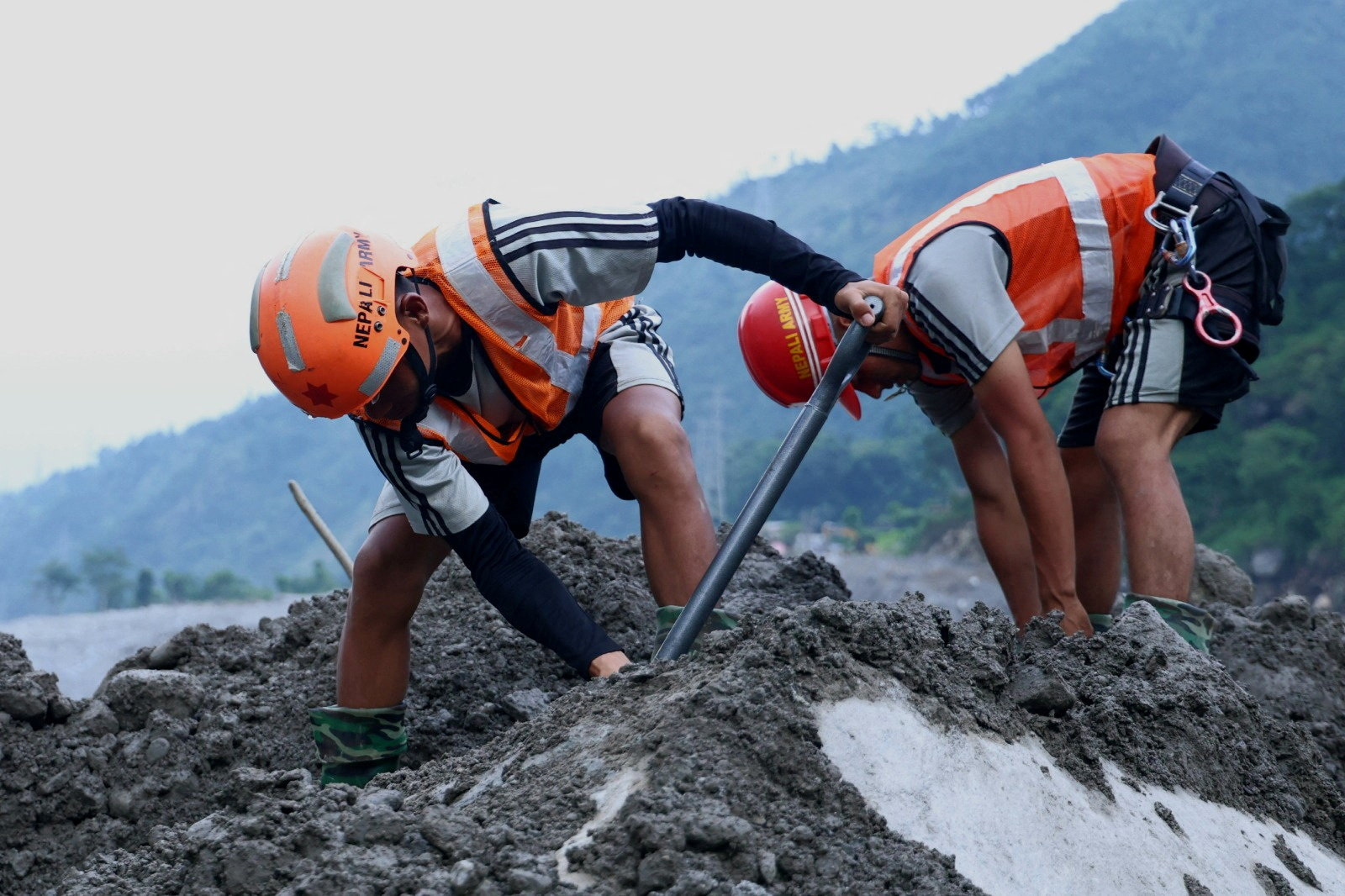
Rescuers in Nepal are scrambling to save more than 900 workers believed to be trapped underground at hydropower projects following last week’s devastating floods, the country’s disaster management authority has said.
At least 933 workers are understood to be stuck in tunnels at about six hydropower projects, the National Disaster Risk Reduction and Management Authority said on Monday.
Recommended Stories
list of 3 items- list 1 of 3Aerial video shows devastation in flood-hit Nepal
- list 2 of 3Photos: Nepal issues alerts as region’s flash flood death toll nears 800
- list 3 of 3Road collapses in Nepal landslide four days after floods
At least 797 people were killed on the border of Nepal and the Chinese territory of Tibet after part of a glacier collapsed in the Himalayas on Wednesday at an altitude of roughly 5,200 metres (17,000 feet) and plunged approximately 1,200 metres (3,900 ft), gathering rock and debris before slamming into the Lhende River in Tibet.
The descent and plunge sent water and debris surging downstream into Nepal, creating a lake across the border that overflowed through the Trishuli and Bhote Koshi river corridors, destroying several villages.
About 3,048 people remain missing.
Nepal said on Sunday that at least 781 had been killed on its side of the border, with 2,502 people missing, including 592 foreign nationals. In China, state broadcaster CCTV reported 16 deaths and 546 people missing, including 261 foreigners.
The Red Cross has estimated that more than 90,000 people are likely to have been affected by the disaster, which China has linked to the effects of climate change.
Rescue operations have been suspended repeatedly since Friday due to poor weather and fears of fresh flooding.
In Nepal, rescue efforts have increasingly focused on hydropower projects inundated by the floods, including the Upper Trishuli complex, where authorities said on Friday they received information that about 350 people could be trapped inside a tunnel. About 10,000 Nepali troops have been deployed alongside specialist teams from China and India.
Troops and engineers drilled through debris on Sunday towards workers believed trapped in a tunnel at one of the sites in the Himalayan river valley after successfully inserting a pipe into the passage.
Workers who managed to get out described horrifying scenes when the disaster struck.
Surendra Dowluri, 33, from India’s Andhra Pradesh state, said that raging water swamped the Upper Trishuli-1 site, where he was working.
“We heard a very loud sound… and saw that the turbine floor was submerged with slush, and six workers were stuck in that,” Dowluri told the AFP news agency in the Nepali capital, Kathmandu, after his rescue four days into the disaster.
“We managed to rescue five of them, but one person lost his life,” he said, describing how some workers reached higher ground or construction areas out of reach of the torrent.
Specialised teams from India, China, and South Korea have joined the search-and-rescue efforts. Malaysia is also deploying its Special Malaysia Disaster Assistance Search and Rescue Team (SMART) and contributing $1m in recovery assistance.
International funding has begun to arrive, with the European Union promising $2.3m on Friday. The International Federation of Red Cross and Red Crescent Societies (IFRC) has allocated more than $1m and launched an emergency appeal for $31m.
Burials start
Authorities in Nepal began burying some of the victims on Sunday after taking DNA samples to allow for future identification. Many bodies were carried away by the floodwaters, leaving families unable to locate and identify their relatives. Mass burials for hundreds of unidentified victims are taking place in Nepal’s scenic Chitwan district, known for its forests and rivers.
Distraught families have packed rescue stations and hospitals in search of their missing relatives, while others have faced the grim task of identifying bodies at overflowing morgues.
Survivors were also faced with the daunting prospect of rebuilding their lives from nothing.
“All the settlements near the river were swept away,” resident Buddhi Ram Dangol told AFP in Nepal’s Nuwakot district.
“There is nothing left.”
